Issue nine · Essay 04 · Narrative
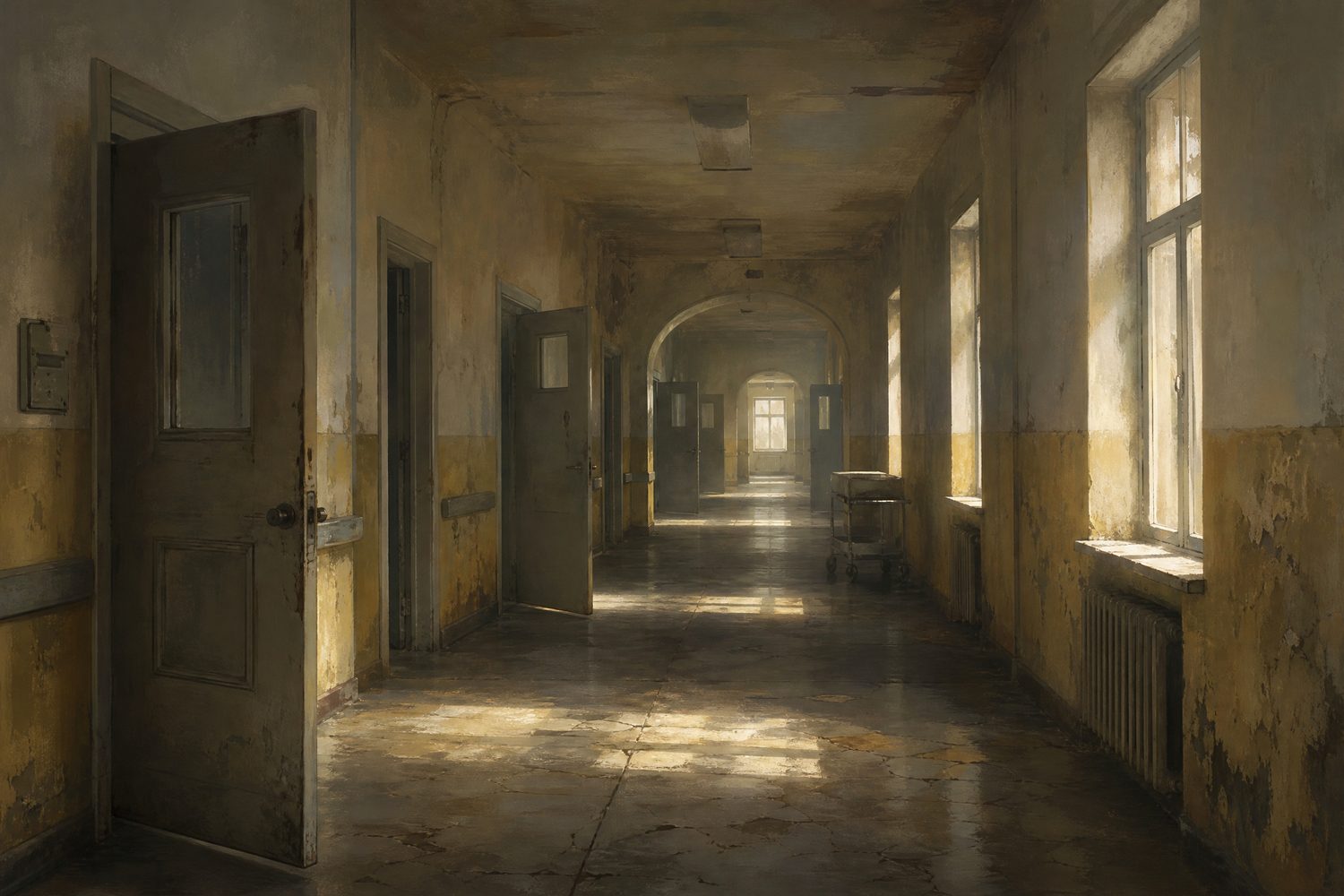
Twenty-two doors, eighteen of them openable, and behind them: nothing. No enemy, no note, no key, no jump. A horror game spends its first seven minutes proving it will not startle you, and then trades on that promise for the remaining nine hours.
Timed across 12 hours · Sixteen silences recorded
Horror games have a spending problem. The genre's cheapest effect — something appears suddenly and loudly — works reliably the first three or four times and then permanently devalues the currency, because a player who has been startled four times knows that doors are triggers and stops treating them as doors. Every subsequent corridor is scanned for trigger geometry rather than inhabited.
This game opens with a corridor containing eighteen openable doors and puts nothing behind any of them. Not a single one. We verified this across three separate playthroughs, opening all eighteen each time, and the corridor's contents never varied: empty rooms, some furnished, one with a mattress, none with an event.
Six minutes fifty-five is the time it took the slowest of us to open all eighteen doors on first encounter. The corridor can be crossed in about fifty seconds if you ignore them. Nobody ignores them, because a horror game's opening corridor is where the player is establishing what kind of game they are in, and door-opening is the natural experiment.
| Reader | Time | Doors opened | Expected an event |
|---|---|---|---|
| One | 6m 55s | 18 of 18 | Until door nine |
| Two | 5m 20s | 18 of 18 | Until door twelve |
| Three | 4m 02s | 14 of 18 | Throughout |
The column that matters is the last one. Two of us stopped expecting an ambush partway through the corridor, and that transition is the actual content of the sequence. The game spent between four and seven minutes of a twelve-hour experience buying a change in how the player holds a door handle.
What the corridor purchases becomes clear about ninety minutes later, in a building with a comparable number of doors and one genuine threat in it. Because the opening established that doors are architecture rather than triggers, the second building can be explored with attention on the space instead of on the mechanism, and when the threat does arrive it is not a jump but a discovery: something is in the room you were already looking at.
You cannot frighten someone who is braced. The corridor exists to unbrace them.
The game maintains this discipline with remarkable consistency. Across twelve hours we recorded four sudden loud events, all of them in the final third, none of them tied to a door, and two of them audible several seconds before they became visible. That is a rate of one every three hours in a genre that averages one every few minutes, and the restraint is measurable in our own notes: the phrase expected something here and nothing came appears eleven times.
The four sealed doors are sealed permanently and never open at any point in the game, which is its own small act of restraint.
No music plays in the corridor. This is worth stating plainly because the standard construction here is a low sustained tone that rises as you progress — a device that tells the player something is coming and is therefore, in this game's terms, a lie. The corridor has footsteps, the door mechanism, and a ventilation hum that is constant and does not modulate.
We timed the acoustic gap separately: six minutes fifty-five with no score at all, which puts it fourth in this issue by length and first by how unusual it is for its genre. Compare the corridor in another horror game we examined, where a musical sting fires on the fourth door and the remaining doors are consequently unopenable in any meaningful sense — you are pressing a button attached to a sound.
Reader three, the one who expected an ambush throughout and opened only fourteen doors, makes the case against. Their view: a game that spends seven minutes on nothing has to be certain the player will still be there at minute eight, and a less patient player simply reads the opening as cheap and unfinished. The corridor has no way to communicate that its emptiness is deliberate.
The counter-evidence is the mattress room, which is the one deliberately placed object in the whole corridor and functions as a signature. Somebody put a mattress in one of eighteen empty rooms, and its presence signals authorship: this space was considered. Whether four minutes is long enough for that signal to arrive is genuinely uncertain, and it did not arrive for reader three.
The claim is narrow. Emptiness in a horror game is not automatically restraint, and most of it is just an unfinished level. What distinguishes this corridor is the ratio: eighteen prepared, openable, individually modelled rooms with zero payload, in a game that has demonstrably built the systems to fill them and uses those systems sparingly later.
The claim is not that horror should be quiet. Two of the four loud events in this game are excellent, and they are excellent because they are the fourth and the eleventh things to happen rather than the first. Silence here is an economic argument about when to spend, not an aesthetic preference for hush.