Issue nine · Essay 03 · Traversal
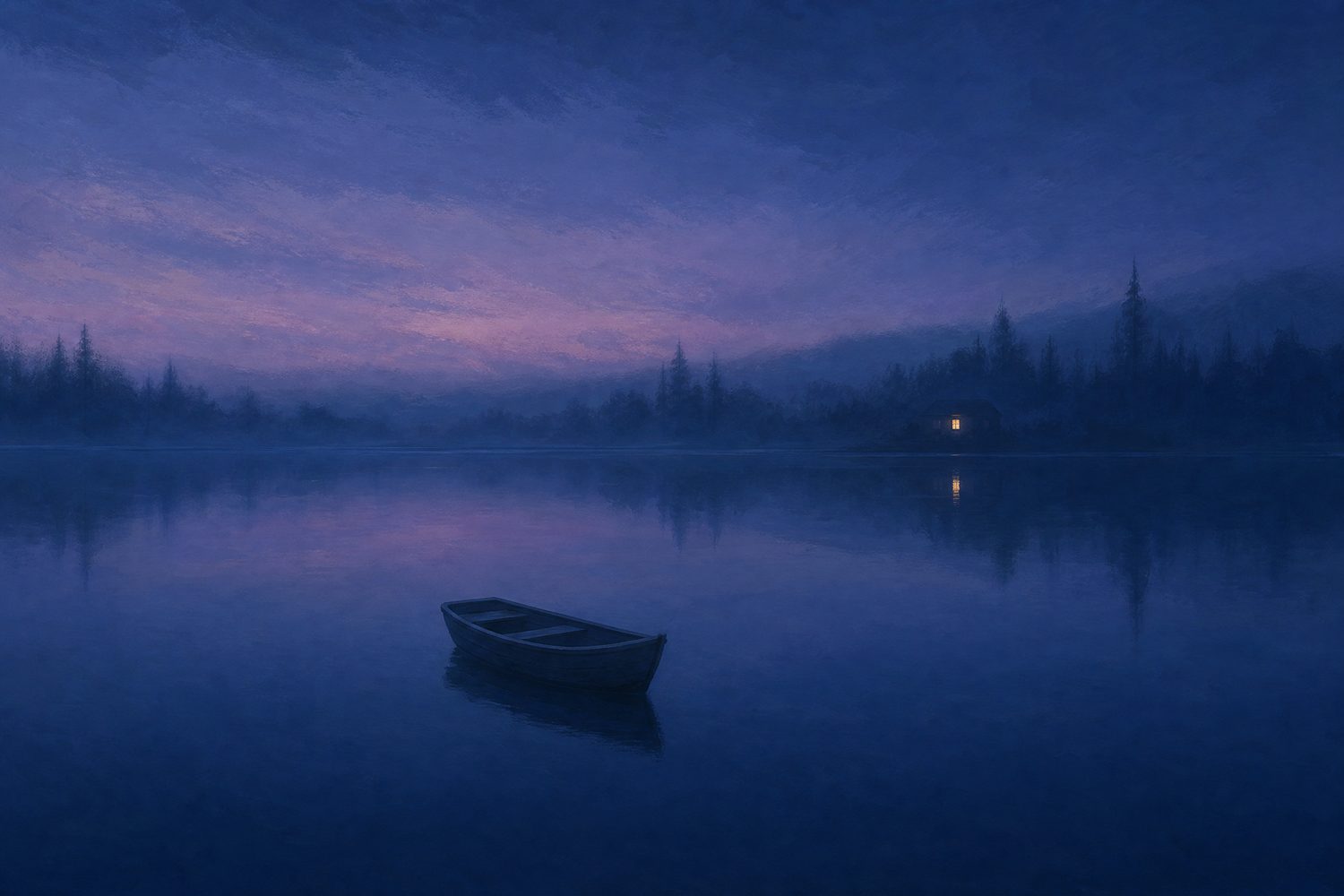
The lake contains no fish, no islands, no encounters, no floating debris and no reward for exploring it. It is fourteen minutes from the near shore to the far one, by hand, with an oar animation that never varies. The emptiness is not an oversight and the tedium is load-bearing.
Timed across 26 hours · Twenty-three silences recorded
The single most common piece of feedback this game received, judging by the discussion we can find, is that the lake should have had something in it. That feedback is wrong, and I think it is wrong in a way that is instructive, because it mistakes the lake for content that was left unfinished rather than a mechanism that was carefully built.
Here is what the lake has: water, a fog bank at variable distance, one lit window on the far shore, and an oar. Here is what it does not have: fish, reeds, wildlife, wreckage, submerged objects, weather variation, a current, a stamina meter, a map, a compass, and any indication of how far across you are. Rowing is a single button held down. The boat moves at one speed.
Navigation across the lake is accomplished by keeping the lit window ahead of you, and this is the design decision the whole crossing rests on. Because the window is a single point of light in fog, it does not indicate distance — only direction. You know you are pointed correctly. You do not know whether you are two minutes out or ten.
We tested this. Asked to estimate remaining time at the halfway point, all three readers were wrong by more than four minutes, and two of them guessed they were nearly there when nine minutes remained. A crossing whose length you cannot estimate is a crossing you cannot ration your attention across, and the result is that you look at the water.
Fog density changes with the in-game hour. Cross at midday and the far treeline is visible, which supplies distance information and reduces the crossing, subjectively, to a chore. Cross at dusk, as the game's structure encourages, and the window is all you have.
Two of our three timed crossings were at dusk. The midday crossing felt, in the words of the reader who did it, like a loading screen with an oar.
The far shore contains a house with one occupant, and a conversation that runs for approximately eleven minutes if you exhaust it. The conversation is the best-written thing in the game. It is also completely unremarkable in isolation: two people in a kitchen, discussing a third who is not there, with no revelation and no raised voices.
The reason it lands is that it took fourteen minutes of rowing to get to, and that the only way back is another fourteen minutes. You cannot leave, glance at a map, take a side quest, or check a marker. The game has engineered a condition in which a quiet conversation is the most interesting available stimulus, and then supplied a quiet conversation.
A game with fast travel could not have written this scene, because the scene depends on the audience having nowhere else to be.
Suppose you took the feedback and put something in the lake. The candidates are all easy to imagine and all destructive:
Fish. A fishing mechanic converts the crossing into an activity with an optimal strategy. You would row while fishing, the attention would go to the mini-game, and the fourteen minutes would pass pleasantly and mean nothing.
An island. One island halves the crossing into two shorter crossings with a rest point, and destroys the property that you cannot stop. Being unable to stop is what makes the water feel like distance rather than terrain.
A submerged object. The moment there is one thing to find in the lake, the lake becomes a search space. Every subsequent crossing is spent scanning, and the water stops being water.
A current. Any variable that rewards skilful rowing turns the crossing into a system to master. Mastery shortens the subjective duration, which is the opposite of what this crossing needs.
Every improvement to the lake makes the conversation on the far shore worse. That is an unusual property and it is worth being explicit about, because it means the emptiness is not neutral space that could have been filled at no cost — it is functioning machinery.
This is where the game's judgement shows. The crossing is compulsory exactly three times across a twenty-six hour game, and after the third crossing a permanent shortcut opens.
| Crossing | Timed | What waits |
|---|---|---|
| First | 14m 12s | The eleven-minute conversation |
| Second | 13m 48s | A short, hostile exchange |
| Third | 14m 03s | An empty house |
Three crossings, forty-two minutes of rowing in total, and the third one ends in nobody being home. That third crossing is the game's real gamble and the reason two of us rate the sequence highly: it spends fourteen minutes of the player's patience on an absence, having twice established that the crossing ends in company.
Then it gives you the shortcut, which is the correct decision and the one most games get wrong in the other direction. A silence that repeats indefinitely stops being a silence and becomes an obstacle. Three is enough. A fourth compulsory crossing would have turned the whole apparatus into a complaint about the game rather than an argument for it.
The nearest comparison in this issue is the snowfield in essay one, which is longer but easier to justify because a survival game has an obvious reason to make distance expensive. The lake is harder to defend and therefore more interesting: nothing about the genre required it, no system depends on it, and it could have been cut to a thirty-second boat animation without breaking anything except the thing it exists to build.