Issue nine · Essay 01 · Traversal
A survival game asked me to cross a snowfield on foot with no companion, no music, no objective marker and no interruption of any kind. I timed the crossing three times. The longest was twenty-two minutes and seven seconds. Nothing happened in any of them.
Timed across 34 hours · Nineteen silences recorded
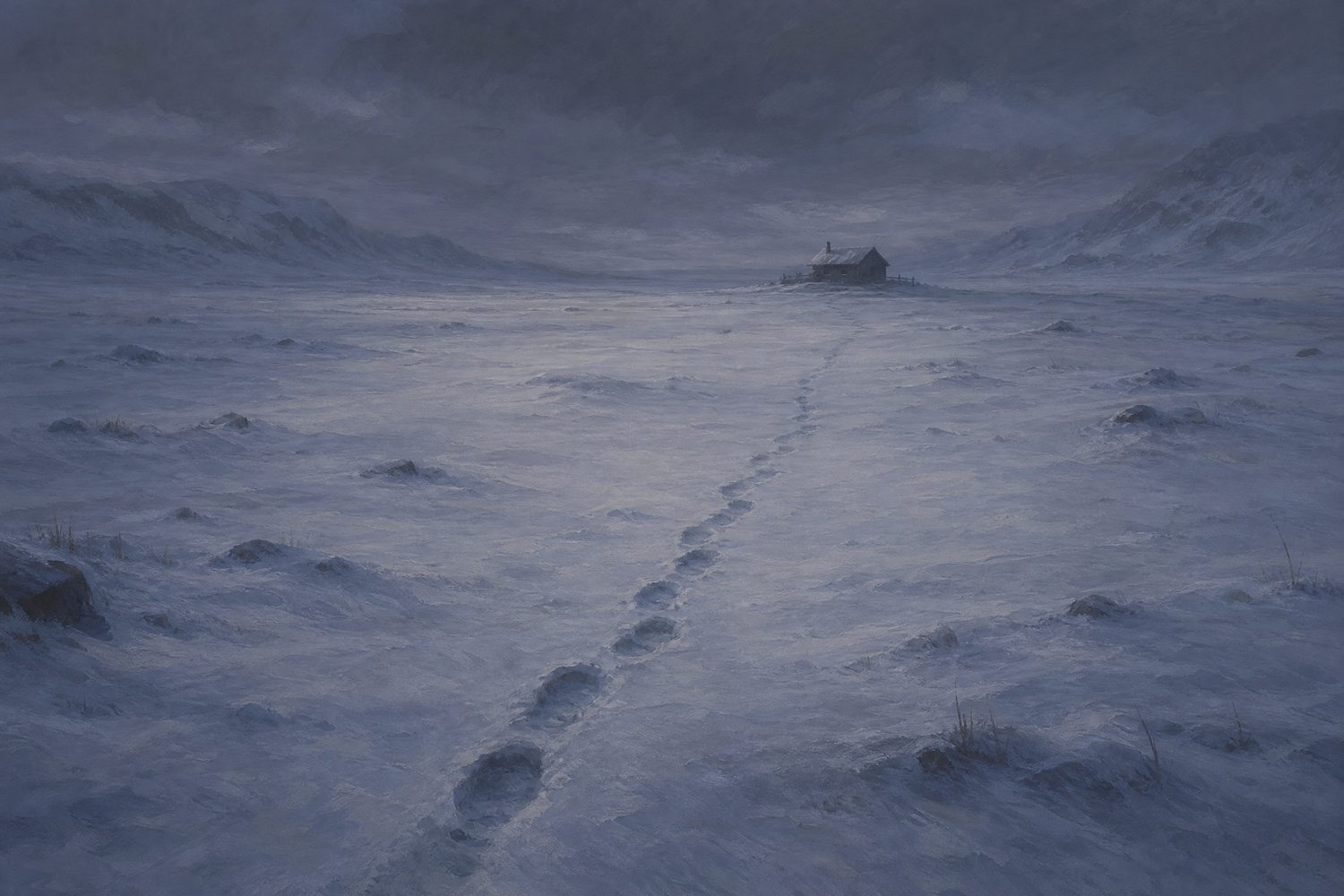
There is a moment about eleven minutes into the crossing where you stop expecting anything. It is quite distinct and I noticed it on all three attempts. For the first ten minutes you are still braced: a game has taught you that a long walk is a delivery mechanism, and something is going to be delivered. A radio call. A wolf. A body in the snow with a note on it. A weather event that forces you to build a fire. Then eleven minutes pass, and the bracing stops, and what is left is walking.
I want to be careful here, because there is a genre of writing about games that treats emptiness as automatically profound, and that is not the argument. Most long walks in most games are badly judged. They exist because a map was built to a scale nobody play-tested on foot, or because a traversal upgrade was cut, or because the studio believed size was a feature. The snowfield in this game is different in one measurable respect: everything that could have interrupted it was clearly built and then deliberately withheld.
This is the part that convinced me the silence was a decision rather than an omission. By the time the crossing happens, the game has already demonstrated a full toolkit of interruptions, all of which it declines to use here.
| System | Used elsewhere | Used in the crossing |
|---|---|---|
| Radio dialogue | 41 times | Never |
| Musical cue on arrival at a landmark | 28 times | Never |
| Wildlife encounter | Frequent | Never |
| Weather event forcing shelter | 16 times | Never |
| Objective marker on the compass | Standard | Absent |
| Collectible or readable | Everywhere | None |
Six systems, all live, all switched off for one stretch of ground. You do not get that by accident. Somebody argued for this in a meeting and won, and I would like to know who they were.
Three crossings, all on the same save, all in the same direction, no fast travel available:
The spread of two and a half minutes is the interesting figure rather than the maximum. A crossing whose length you cannot substantially reduce by playing well is a crossing the game intends you to experience at roughly one length. There is no sprint that meaningfully changes it, no stamina system to optimise, no shortcut to find. Nineteen minutes forty is the floor, and the floor is high.
Snow depth varies with the route. Staying on the wind-scoured ridge line is perhaps ninety seconds faster than crossing the drifts, and learning that is the only skill the crossing rewards. It is also the only reason the second crossing came in under twenty minutes.
The cabin at the far end contains one dead character, four lines of written text and a working stove. In a game that had interrupted the crossing five times, that cabin is a waypoint. Because the crossing was silent, the cabin is an event, and the stove — a mechanical convenience, a place to cook — reads as extraordinary relief.
The crossing does not make the cabin better. It makes the cabin arrive.
This is the whole argument of the essay and it is not a mystical one. Contrast requires a baseline, and a game that is continuously eventful has no baseline against which any individual event can register. The snowfield is nineteen to twenty-two minutes of baseline, purchased at real cost, and the game spends it on a single stove.
Two of the three readers who tried this crossing on our recommendation disliked it, and I think their objection is legitimate rather than a failure of patience. One stopped at around fourteen minutes and looked up whether anything happened at the far end. The other completed it and described it as a design that offloads the work of finding meaning onto the player without guaranteeing there is any.
That second criticism is the sharp one. A silence is a gamble: if the payoff at the end is thin, the player has been asked to invest twenty minutes of attention in exchange for nothing, and they are entitled to be annoyed. The reason this particular crossing survives the objection is that the payoff is not a plot revelation but a change in mechanical state — warmth, cooking, safety — which lands regardless of how invested you were in the story.
Three changes, any one of which would ruin the crossing, and all three of which appear in comparable games elsewhere in this issue:
A marker. Put a distance counter on the cabin and the walk becomes a progress bar. We timed a comparable crossing in another game with a marker present and the difference in how it reads is total: with a number ticking down, every minute is a minute of not having arrived yet.
Music. A score that swells at the halfway point would tell you that the walk means something, which is precisely the thing the walk has to establish on its own. Fifty-four per cent of the stretches we timed this issue had music fade in before the two-minute mark, and every one of them felt shorter and mattered less.
One interruption. A single wolf at minute twelve would convert the entire crossing retrospectively into an approach to a wolf encounter. The eleven-minute moment where you stop expecting things would never occur, because the game would have proved you were right to expect them.
We assumed the crossing was the longest silence in the game. It is not. A stretch on a frozen river in the last third runs to twenty-four minutes with no dialogue and no music, and none of the three of us remembered it at all. The difference is that the river crossing is optional, it has a fast-travel point at both ends, and it leads to a cache of supplies rather than to a change of circumstance.
So length is not the variable. A silence works when it is compulsory, unshortenable, and terminates in something that alters the player's situation. That is a narrow set of conditions, which may be why only twelve per cent of the gaps we timed this issue lasted five minutes without the game reaching for something to fill them.