Issue nine · Essay 02 · Occupancy
A disused waiting hall with twenty benches, of which one can be sat on. No achievement, no timer, no journal entry, no effect whatsoever on the game state. Three readers sat there for more than eight minutes each, and the fact that it accomplished nothing is the point.
Timed across 18 hours · Eleven silences recorded
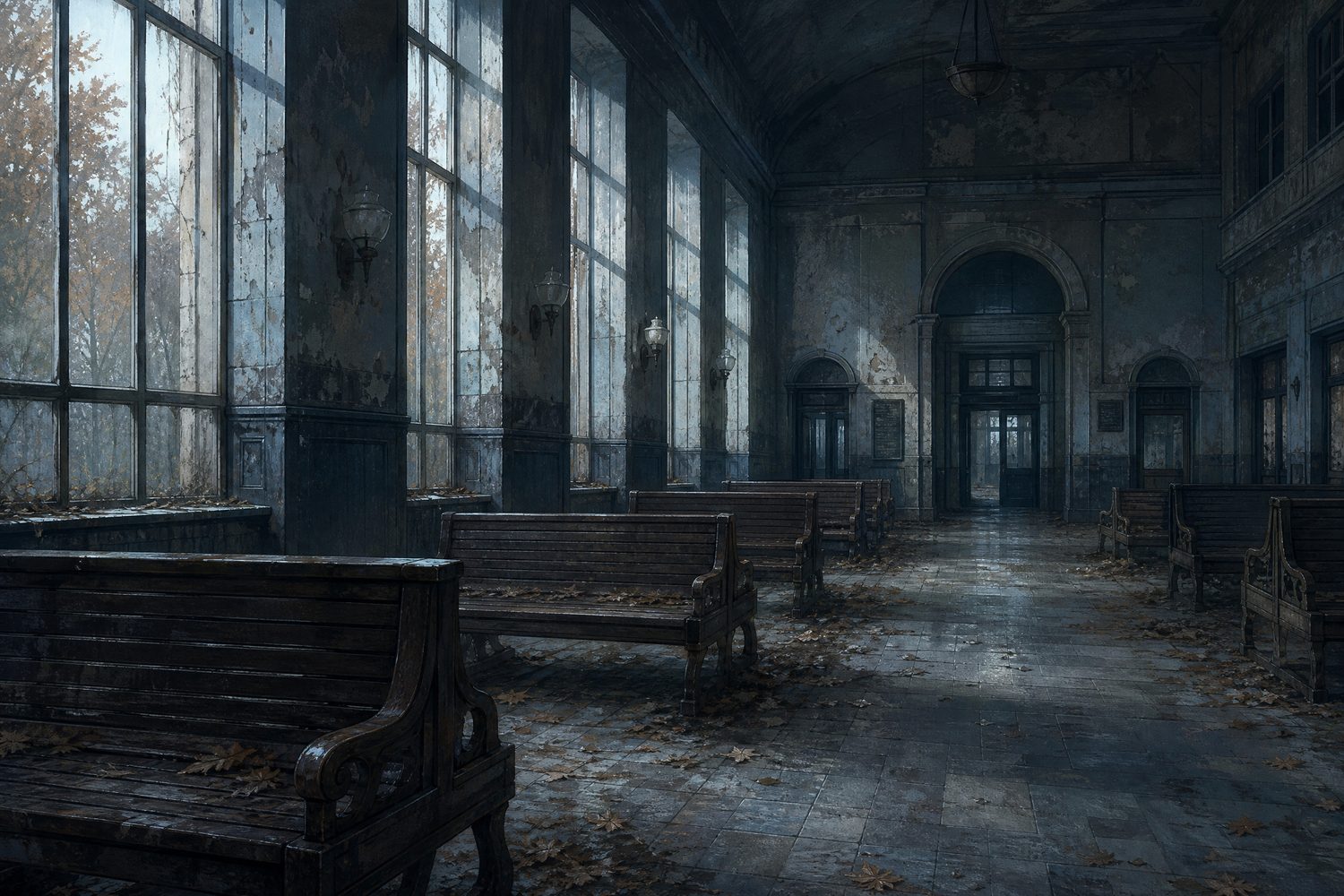
Almost every game lets you stop moving. Very few let you sit, and of those that do, nearly all attach something to it: a rest mechanic that advances time, a save point, a health regeneration tick, a camera flourish, an achievement, a companion conversation triggered on the seat. This hall attaches nothing. You press a button, the character sits, and the game waits.
Timing this was awkward, because unlike the traversal essays in this issue there is no natural end point. We settled on recording how long each reader remained seated on first encounter, before standing up voluntarily, with no instruction to linger.
| Reader | Seated | What they did |
|---|---|---|
| One | 8m 40s | Rotated the camera; watched leaves on the floor; waited for something |
| Two | 2m 05s | Stood up as soon as it was clear nothing would happen |
| Three | 6m 12s | Sat, went to make tea, came back, stood up |
Reader two's two minutes is the honest figure and reader one's eight minutes is the interesting one. What reader one was doing, by their own account, was waiting to find out what the sitting was for — and the game's refusal to answer eventually became the answer.
Consider what a single reward would do. Attach a five-minute timer and an achievement, and the bench becomes a task: sit for five minutes, receive a trinket, never sit again. Attach a companion monologue and the bench becomes a dialogue trigger, which is to say a button that happens to be a bench. Attach time advancement and the bench becomes a tool for skipping to night.
All three of those are common and all three of them destroy the property that makes this hall memorable, which is that sitting is permitted rather than incentivised. The game has no interest in whether you sit. It has merely made it possible, and made the room worth being in while you do.
Almost everything a game lets you do, it also wants you to do. This is the rare exception.
If the bench pays nothing, the room has to hold attention on its own, and it does so with detail that changes on no schedule and rewards no scrutiny. There is no hidden note in the hall, no lore document, no readable timetable, nothing to photograph for a collection. What there is:
That last one is doing most of the work. The bands of light on the floor visibly rotate across an eight-minute sit, and that is the only thing in the room that changes. It is the difference between an empty room and a still one.
No score plays in the hall at any point in the game. The ambience is wind against glass, a periodic creak, and — once, at around the four-minute mark on two of our three sits — a distant sound we could not identify and could not reproduce. We have listed it as unexplained rather than pretending to know what it was.
The hall is placed immediately after the game's only genuinely stressful sequence and immediately before its longest dialogue scene. That is not a coincidence and it is the most conventional thing about it: a decompression room between two demands, which is a technique as old as level design.
What is unconventional is that decompression rooms are usually corridors — you walk through them slowly and the pacing is imposed on you at a fixed rate. This one is a room you can leave in twelve seconds if you want to, which means the decompression is offered rather than administered. Reader two took the twelve seconds. Reader one took eight minutes and forty seconds. Both were correct.
Two other games in this issue contain sittable furniture. One of them advances the clock by an hour per sit and is used exclusively as a time-skip button; we timed a median of four seconds per use across dozens of instances. The other awards an achievement for sitting on twenty different chairs, and reader three duly hunted chairs for ninety minutes and never once sat on one for longer than the achievement required.
| Attached to sitting | Median time seated | Recalled later |
|---|---|---|
| Nothing (this game) | 6m 12s | All three readers |
| Time advancement | 4s | Nobody |
| Achievement for twenty chairs | 9s | As a chore |
Attach a use to sitting and the player will use it. Attach nothing and some of them will sit. The two behaviours look identical in a telemetry dashboard and have nothing in common.
An unrewarded bench is invisible to most players, and a feature that most players never notice is expensive to justify. Reader two's position is that the hall is a designer's indulgence: a nice room, a courtesy animation, and no mechanism to bring anybody's attention to it.
That is true, and I would still build it. The cost is one animation and one interaction volume. The return is that the small number of players who do stop find a game that had anticipated them, and there is no way to obtain that effect while also advertising it.