Issue nine · Essay 05 · Traversal
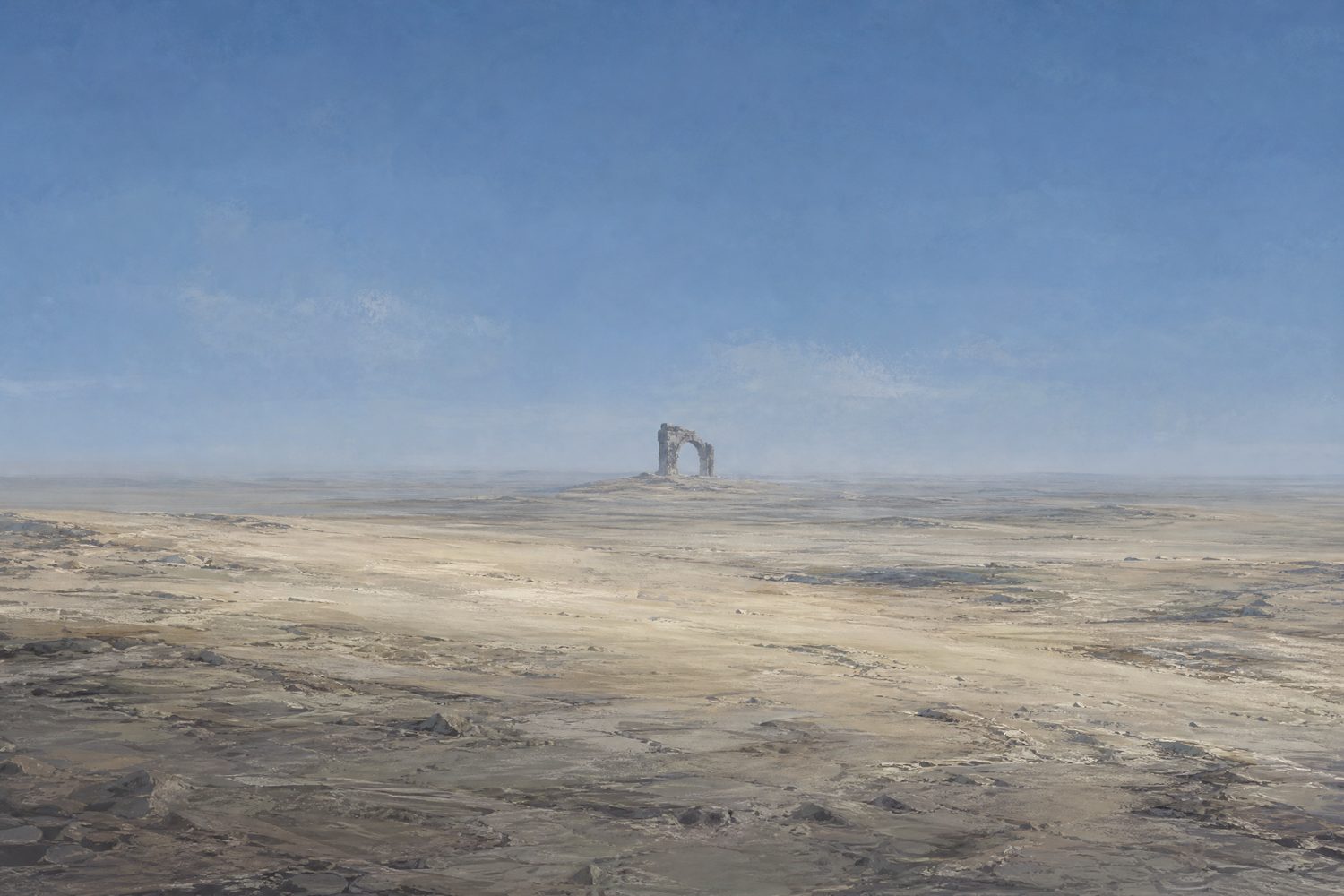
A ruined arch stands on the horizon of a desert plateau, visible from the moment you leave the last settlement. There is nineteen and a half minutes of flat rock between you and it, no quest attached, and nothing whatever happens when you arrive. All three of us walked to it.
Timed across 52 hours · Twenty-eight silences recorded
Open-world games have largely solved the problem of getting you to want to go somewhere. Put a tower on a hill, mark it faintly, attach a reward, and the player will cross any amount of terrain to reach it. What this game does is remove every part of that apparatus except the tower, and the result is the purest example of voluntary traversal in this issue.
The arch has no map icon. It is not mentioned in dialogue. It does not appear on any quest list, and there is nothing at its base: no chest, no readable, no vista unlock, no achievement. It is a piece of geometry on a horizon, and the game's only contribution is that you can see it from a very long way away and that the intervening ground is walkable.
Because the arch is not an objective, there is no route. We each took our own line and timed it, which gives us three quite different figures for what is nominally the same distance.
| Reader | Time | Route | Stops |
|---|---|---|---|
| One | 19m 30s | Straight line across open rock | None |
| Two | 26m 14s | Followed a dry riverbed most of the way | Four |
| Three | 31m 02s | Detoured to two rock formations en route | Seven |
Nineteen thirty is therefore the floor rather than the length, and the spread of eleven and a half minutes tells you something the snowfield in essay one does not: this silence is elastic. The player sets its duration, because the player set the goal.
The conventional explanation is that players are compulsive and will walk toward anything tall. I do not think that survives contact with the evidence, because this same game contains four other tall visible structures, all of them with rewards attached, and none of them produced this behaviour in any of us. We went to those because the game told us to. We went to the arch because it was there.
The distinction matters and it is measurable in the ambience. During the walk, the following things do not happen: no music, no companion, no dialogue, no marker, no distance counter, no ambient encounter, no weather event. What does happen is that the arch grows steadily larger, and that is the entire feedback system. It is a progress bar made of parallax.
The reward for walking to the arch is that the arch stops being far away.
That sounds like a joke and it is not. Approach is a satisfying process independent of what waits at the end, provided the approach is legible. You can see how far you have come by looking behind you at the settlement, and how far remains by looking at the arch, and no interface is required for either.
Nothing. There is no sound cue, no camera move, no journal entry, no achievement and no change to any counter. You can stand under the arch and look through it at more plateau. One of us climbed it and found that the collision geometry is complete but unremarkable.
This absence is the strongest evidence that the arch is deliberate. A landmark added late, to fill an empty region, would have had something bolted to it.
Reader three, the one whose walk took thirty-one minutes, arrived at the arch and was straightforwardly angry. Their position: the game had used the visual grammar of a reward — distinct silhouette, deliberate placement, clear sightline — to obtain half an hour of walking, and then declined to honour the contract that grammar implies.
I think that criticism is correct on its own terms and I think the game is right anyway. If every distinctive silhouette in an open world contains a chest, then the world is a delivery system and the landscape is packaging. A world in which some tall things are simply tall is a world where looking at the horizon is an act of interpretation rather than shopping. But the cost of establishing that is real, and it is paid by players who trusted the convention.
The game supplies its own control group. Roughly eight kilometres east there is a second arch, structurally near-identical, and this one is marked, because a quest sends you to it in the second act. We timed that approach too: seventeen minutes forty from the same settlement, in a straight line, with a distance counter present.
| Condition | Unmarked arch | Marked arch |
|---|---|---|
| Fastest walk | 19m 30s | 17m 40s |
| Distance counter | Absent | Present throughout |
| Music | None | Fades in at 3m |
| Recalled a year later | All three readers | One reader |
Two minutes shorter, fully signposted, scored, and functionally forgotten. The marked arch is a task that was completed. The unmarked one is a place that was visited, and the only mechanical difference between them is what the game chose not to display.
The instinct, when playtesting reveals a large region with nothing in it, is to add content. This game suggests a cheaper alternative: add one visible, unrewarded, deliberately placed object, and let the emptiness become the distance to it. That costs one asset and no systems work, and it converts dead ground into an approach.
It also fails completely if the object is generic. There are dozens of rock formations on this plateau and nobody walked to any of them. The arch works because it is obviously made rather than grown, and because it is the only made thing in view. One deliberate object in a large empty space is a destination; five are set dressing.